Mission
To make intent-first, observable software the default for serious products: a single pipeline for the traffic that matters, with flows and agents that keep rules and side effects explicit—so quality scales with your team, not despite it.
Presentación de Omega. El contenido del sitio aparecerá en breve.
Better together
Omega is a product architecture for intent-first systems: one observable channel, typed intents, explicit flows, and agents that own side effects—so behavior stays inspectable from prototype to production.
Concept Code Production

Why Omega exists—and the future we are building for teams who think in systems: one language for product, design, and engineering.
To make intent-first, observable software the default for serious products: a single pipeline for the traffic that matters, with flows and agents that keep rules and side effects explicit—so quality scales with your team, not despite it.
Omega is the shared map from sketch to operations: the same concepts—channel, intents, flows, agents—in roadmaps, reviews, and telemetry—so every discipline aligns without re-learning the stack on every release.
Modern development piles on boilerplate, competing architectures, and endless decisions. Omega brings one model—channel, intents, flows, agents—so teams move from complexity to clarity.
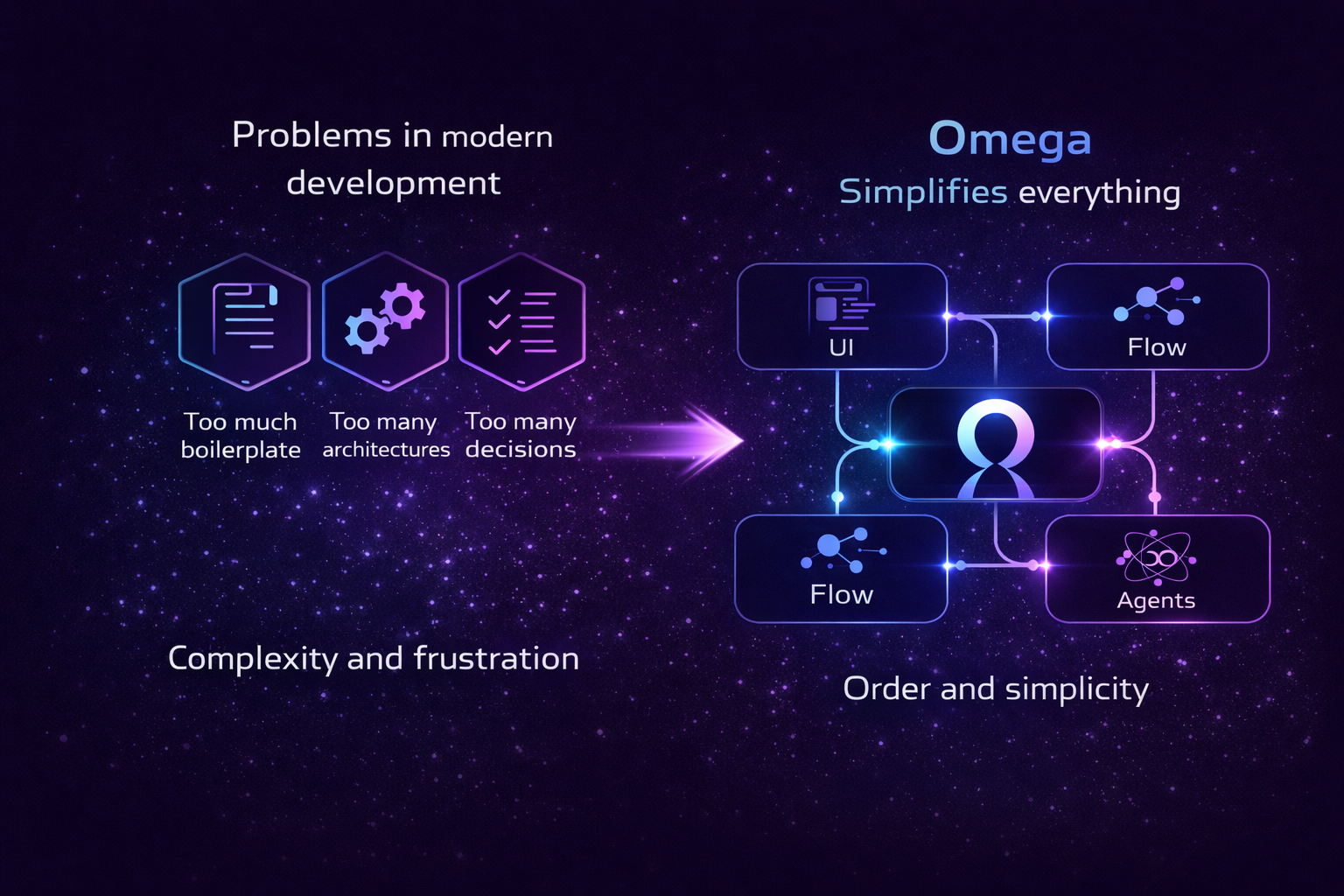
Three ideas that stay true no matter which runtime you ship on: a single observable channel, explicit orchestration, and agents that keep the world honest.
One bus for what matters: every important signal flows as events you can subscribe to, trace, and reason about—no hidden callbacks scattered across layers.
See how it fits togetherThe UI speaks in intents; flows own feature logic and routing. Orchestration stays explicit and testable instead of buried in widgets or controllers.
Concepts in depthSide effects and integrations live in agents that listen on the channel—so IO stays at the edge and your product surface stays thin and predictable.
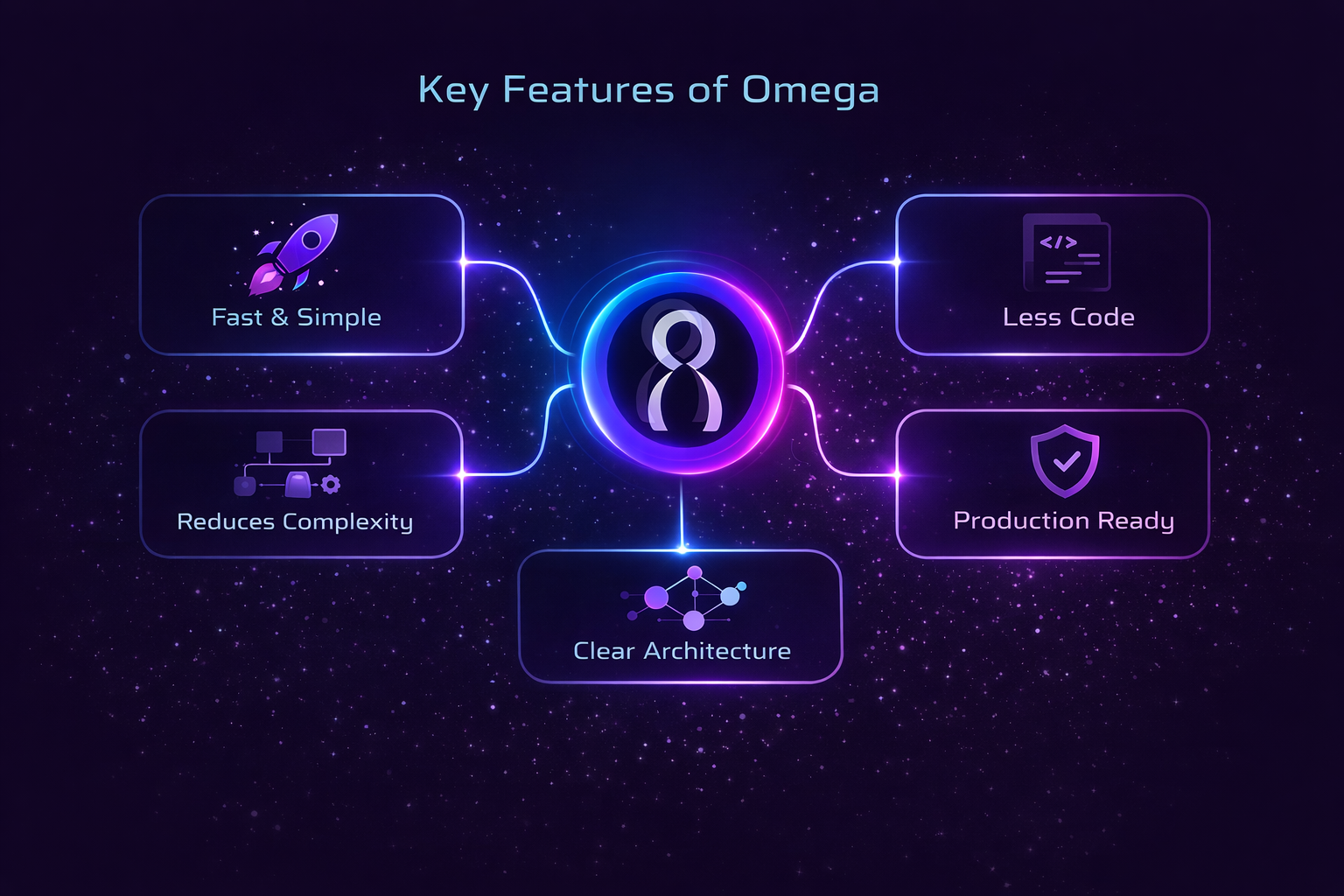
Read the modelFast to adopt, less code to maintain, clearer architecture, and production-ready patterns—one hub that ties UI, flows, and agents together.
Omega is a reactive, intent-first architecture: all important traffic goes through one
OmegaChannel as OmegaEvent values. The surface issues OmegaIntent commands;
flows orchestrate business rules; agents run side effects and IO—so presentation stays thin
and the pipeline stays observable.
OmegaIntentName, OmegaEventName),
OmegaIntent, OmegaEvent, shared OmegaObject base.
OmegaChannel implements OmegaEventBus; use
namespace('auth')-style views to scope modules without name collisions.
OmegaFlowManager registers flows and routes intents;
OmegaFlow handles intents and channel events; OmegaAgent listens to the bus for behaviors.
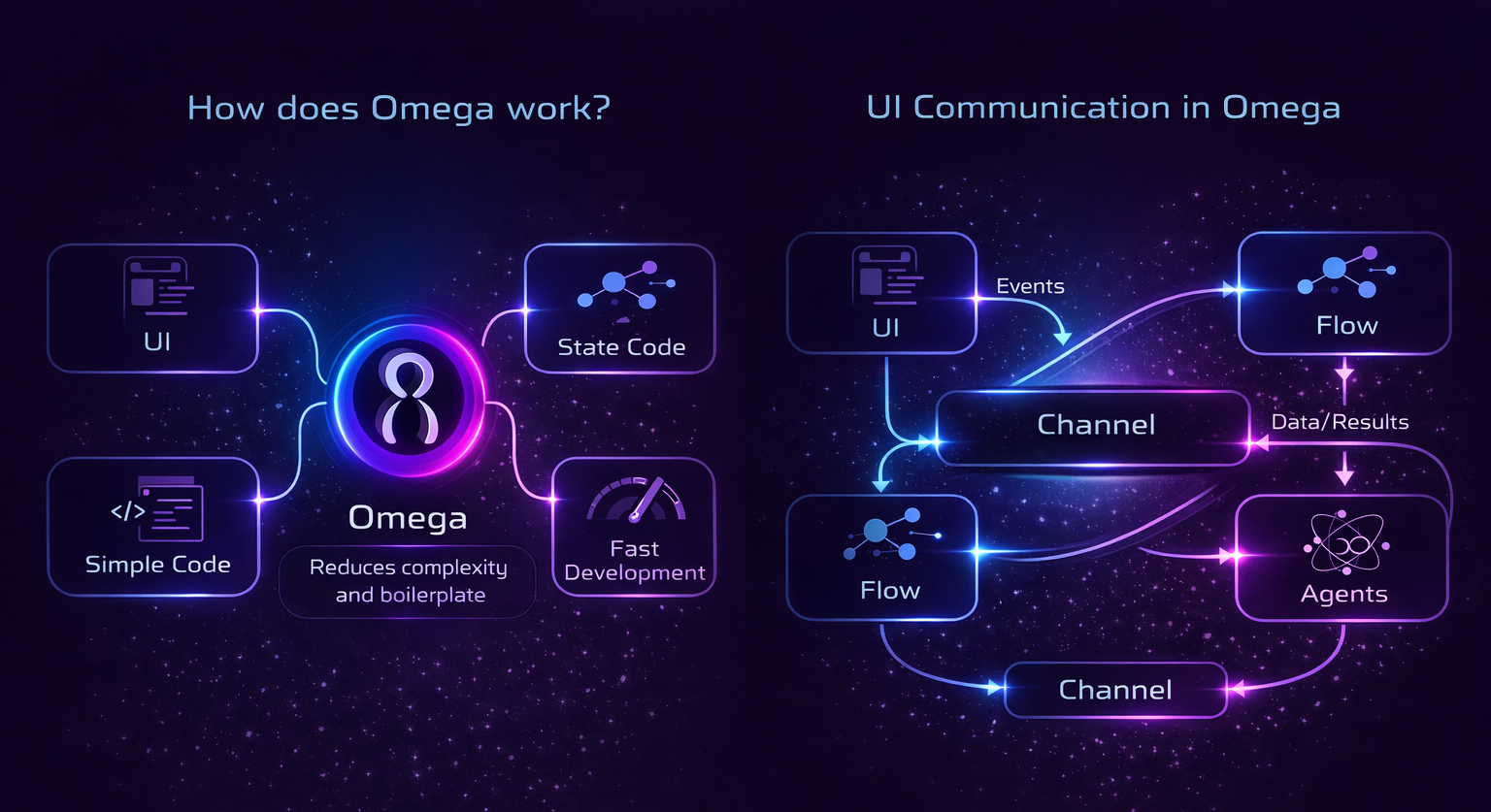
The UI issues intents; the channel carries events everyone can observe. Flows orchestrate feature logic and agents handle side effects—so the surface stays thin and every crossing between UI and engine stays explicit.
Omega ships as libraries you embed in your delivery stack. The same conceptual model applies; each runtime adds its own tooling and wiring. Pick the track that matches how you build and ship.
Channel, intents, flows, agents—keep UI thin and behavior inspectable.
Inspector, VM Service, time-travel traces, and the omega CLI.
ESLint-before-serve, ng add, feature schematics, and router integration.
Package omega_architecture — reactive, agent-based apps with deep observability.
Package omega-angular — guardrails that keep the model consistent as the app grows.
Vision and why
Data flow
Tooling depth differs by platform—for example, the mobile track emphasizes inspector and trace workflows today. See each site’s guides for the authoritative feature set and compatibility notes.
The same names and responsibilities wherever Omega runs: channel, intents, flows, and agents—before you pick a runtime SDK.
OmegaEvent or emitTyped; subscribe to events as reactive streams (your SDK maps to the platform’s stream type).
name, optional payload and namespace; created with fromName for typed enums.
onIntent + onEvent. Some runtimes expose richer UI hooks (e.g. expression streams) or a slimmer emit surface—see the integration you ship.
When you integrate Omega on more than one stack, the public APIs stay aligned; behavior still differs where the
frameworks diverge. Below is a concise map for implementers (omega_architecture · omega-angular).
| Topic | Flutter | Angular |
|---|---|---|
| Channel implementation | Broadcast Stream<OmegaEvent> |
RxJS Subject → Observable (multicasted; no replay) |
OmegaFlow → UI |
expressions stream + lastExpression; optional OmegaFlowExpressionBuilder |
Flows emit via channel (protected emit); no first-class expression stream in the base class |
| Flow activity | OmegaFlowState (idle, running, …); start / pause / switchTo — _runningFlows holds all flows currently running |
activate / deactivate / switchTo — activeFlowIds is the set that receives intents and channel events |
handleIntent |
Optional registerIntentHandler first (can consumeIntent); then receiveIntent on each running flow |
onIntent on each active flow (insertion order) |
OmegaAgent |
Abstract class + OmegaAgentBehaviorEngine, agent inbox/protocol, optional flow contract |
Concrete class: engines + onReaction; destroy() unsubscribes |
| Bootstrap | OmegaRuntime.bootstrap — channel, OmegaFlowManager, OmegaAgentProtocol, OmegaNavigator, routes |
provideOmega({ createFlows, bootstrap?, createAgents? }) in Angular DI + APP_INITIALIZER |
| UI wiring | OmegaScope, navigator key, inspector receivers/servers |
Inject OmegaChannel / OmegaFlowManager in components & services |
| Extra in package | Time-travel recorder, offline intent queue, inspector & VM tooling, flow contracts (debug) | ESLint-first builders, schematics, ng add wiring (see repo tooling) |
Same symbols in both reference libraries where concepts align. See each package’s API docs on pub.dev / npm for signatures.
| Concept | Flutter (omega_architecture) |
Angular (omega-angular) |
|---|---|---|
| Event bus abstraction | OmegaEventBus · OmegaChannel · OmegaChannelNamespace |
OmegaEventBus · OmegaChannel · OmegaChannelNamespace |
| Intent / event payload | OmegaIntent, OmegaEvent, OmegaTypedEvent |
OmegaIntent, OmegaEvent, OmegaTypedEvent |
| IDs & wire names | OmegaFlowId, OmegaAgentId, intent/event name enums |
OmegaFlowId, OmegaAgentId, intent/event name enums |
| Orchestration | OmegaFlow, OmegaFlowManager |
OmegaFlow, OmegaFlowManager |
| Agents | OmegaAgent, behaviors, protocol |
OmegaAgent, OmegaAgentBehaviorEngine |
| App entry (examples) | OmegaRuntime, OmegaConfig, app omega_setup.dart |
provideOmega, consumer omega-setup.ts |
| Navigation | OmegaNavigator, OmegaRoute, intent-driven routes |
Angular Router integration (guides) |
| Tooling (ecosystem) | omega CLI, inspector, traces |
ESLint plugin, schematics, ng add omega-angular |